
How Alan Kulwicki Out-Calculated NASCAR (And Put Hooters on the Map) in 1992
Two laps. That is all it took for the greatest championship finale in stock car racing history to descend into pure bedlam. On Lap 2 of the 1992 Hooters 500 at Atlanta Motor Speedway, pole-sitter Rick Mast tangled with Brett Bodine entering Turn 1. The resulting metal-shearing melee sent shockwaves through the field, spitting out debris that tore a crush panel clean off Davey Allison’s Ford. Allison entered the afternoon as the points leader and the odds-on favorite to hoist the Winston Cup. Before his tires had even reached operating temperature, his title run was hemorrhaging aerodynamic stability.
The afternoon of November 15, 1992, was already thick with historic consequence. A crowd of more than 160,000 had packed into the Georgia venue to witness the changing of the guard. Richard Petty was climbing into his iconic Petty Blue and day-glo red No. 43 Pontiac for his 1,185th and final NASCAR Cup start. Rolling off 21st on the grid was a fresh-faced, 21-year-old open-wheel phenom named Jeff Gordon, making his premier-series debut in the rainbow-colored No. 24 Chevrolet. Bookending the sport's past and future would have been enough to make the weekend legendary, but the title fight itself defied historical precedent: a record six drivers entered Sunday mathematically alive for the Winston Cup—Davey Allison, Alan Kulwicki, Bill Elliott, Harry Gant, Kyle Petty, and Mark Martin.
Yet when the dust cleared, the smoke settled, and the engines cooled, chaos had not decided the championship. A fiercely independent mechanical engineer armed with a pencil and a legal pad did.
The Short Version: 10 Points and One Extra Lap
To understand the magnitude of what unfolded in Atlanta, you have to look at the scoreboard first. When the checkered flag waved after 328 grueling laps, Alan Kulwicki secured the 1992 NASCAR Winston Cup championship by a margin of just 10 points over Georgia’s native son, "Awesome Bill" Elliott. At the time, it stood as the closest points finish since NASCAR instituted its modern-era scoring system in 1975.
The irony? Kulwicki did not win the race. Bill Elliott did. Elliott drove a brilliant, emotional contest in front of a hometown crowd that desperately wanted to see him capture his second series crown. Elliott crossed the line first, took the trophy, and collected the winner's payout. But Kulwicki took home the championship hardware because he crossed the line in second place and earned the five-point bonus for leading a lap, plus an additional five-point bonus for leading the single most laps of the race. Kulwicki beat Elliott to the title by virtue of leading exactly one more lap than the race winner.
An Engineer’s Degree, Run Like an Engineering Problem
Alan Kulwicki was an anomaly in the southern-dominated, gut-instinct world of late-20th-century NASCAR. Born and raised in Greenfield, Wisconsin, he earned a bachelor of science degree in mechanical engineering from the University of Wisconsin–Milwaukee. Where traditional racers relied on the seat of their pants, track rumors, and superstitious folklore, Kulwicki relied on physics, geometry, and meticulous data collection. He documented track temperatures, spring rates, roll centers, and gear ratios in exhaustive spiral testing notebooks. To Alan, a 3,400-pound stock car was not an iron beast to be wrangled; it was a dynamic engineering problem awaiting a mathematical solution.
That analytical mindset bred a fierce, uncompromising independence. When Kulwicki arrived in North Carolina in 1985 with a pickup truck and an open trailer, industry veterans told him he had to align with an established powerhouse to survive. Later, as his reputation grew, he was offered the coveted seat in Junior Johnson’s championship-winning stable—a ride that virtually guaranteed double-digit victories. Kulwicki flatly turned it down. He refused to give up operational authority over his equipment, choosing instead to build AK Racing from the ground up as a solo owner-driver. If he won, it would be under his terms; if he failed, he would answer only to his reflection.
His work ethic leaned into the obsessive. Kulwicki was famous for conditioning his body inside a sweltering car during southern midsummers, running test sessions in full triple-layer driving suits without cool suits or fresh-air blowers to condition his mind to function through heat exhaustion. He noticed every aerodynamic flaw and mechanical compromise.
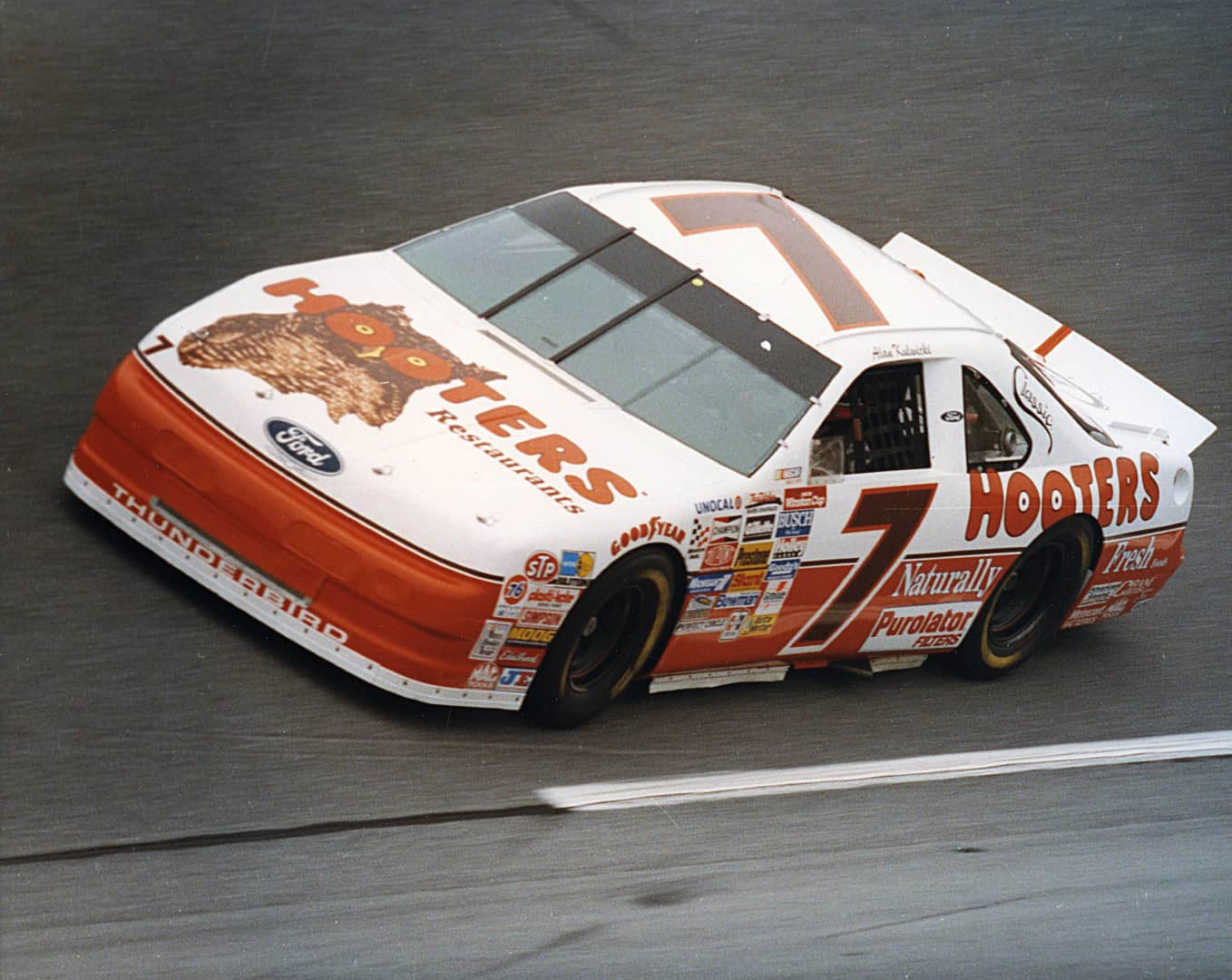
That uncompromising individuality showed up boldly on the nose of his race car. Before the 1992 season finale, Kulwicki used a razor knife to slice the "Th" off the plastic Ford Thunderbird emblem on his front bumper, leaving the letters underbird. Adjacent to it sat the logo of his new primary sponsor, Hooters, with its wide-eyed owl standing in for the letter "O." The Underbird was born: an overt middle finger to the corporate multi-car operations that dominated the garage, piloted by an outsider who embraced his underdog status as an operational advantage.
The Math That Mattered More Than the Win
Under the Latford points system that governed NASCAR in 1992, race finishes only told part of the story. Strategy lived in the margins:
- A race victory awarded 175 points; second place awarded 170 points.
- Any driver who led at least one lap during the event earned a 5-point bonus.
- The driver who led the absolute most laps earned an additional 5-point bonus.
As the race wore on and Davey Allison's damaged car inevitably crashed out of contention following a mid-race collision with Ernie Irvan, the championship narrowed to a head-to-head tactical duel between Elliott’s Junior Johnson-owned Ford and Kulwicki’s self-prepared Underbird.
Sitting atop the pit box was Kulwicki’s crew chief, Paul Andrews. Between fuel calculations and tire wear assessments, Kulwicki and Andrews monitored the lap charts with clinical precision. They were not racing the cars around them; they were racing the rulebook. Through the radio static, Kulwicki continually demanded lap-count updates, calculating how long he needed to hold the lead before surrendering the track to Elliott for his final scheduled fuel stop.
The magic number was 103 laps. If Kulwicki led 103 circuits, Elliott could lead no more than 102 of the 328-lap distance. That single-lap disparity guaranteed Kulwicki the maximum 10 bonus points. On Lap 310, having officially ticked off his 103rd lap out front, Kulwicki dove onto pit road for a splash of fuel and two tires, handing the lead back to Elliott. Elliott led the remaining 18 laps to capture the race win, but the trap had already sprung. Elliott led 102 laps. Kulwicki had led 103 laps. Elliott collected 180 points for the win and a lap-led bonus. Kulwicki collected 180 points for second place, a lap-led bonus, and the most-laps-led bonus. The five-point gap between first and second place was completely erased, preserving Kulwicki’s pre-race cushion and handing him the championship by precisely 10 points. It was an operational masterclass in risk mitigation.
The Polish Victory Lap
When Kulwicki cleared tech inspection as the Winston Cup champion, the grandstands roared in recognition of an all-time upset. But Kulwicki was not interested in standard celebratory donuts. Instead, he unbuckled his belts just enough to sit upright, spun his Ford Thunderbird around in Turn 4, and drove clockwise—backward—around the oval.
Dubbed the Polish Victory Lap, the reverse circuit was Kulwicki’s proud, self-effacing nod to his heritage, first unveiled after his breakthrough victory at Phoenix in 1988. More than an ethnic tribute, it had an engineer's practical intent: by driving clockwise around the facility, the driver’s side of the car was turned directly toward the grandstands. Kulwicki could lower his window net, lean out of the car, and look directly into the faces of the working-class fans cheering him on, waving his gloved hand without an unyielding sheet of sheet metal in the way. It defied NASCAR convention, thrilled the crowd, and cemented Kulwicki's place in American motorsport lore.
The Brand on the Hood
Prominently displayed across the hood of the Underbird was bright orange lettering and an owl named Hootie. The Hooters NASCAR sponsorship was central to Kulwicki’s championship run, yet the company had arrived on the national sports scene almost entirely by accident.
On April 1, 1983, six Clearwater, Florida businessmen with zero restaurant experience—self-styled the "Hooters Six"—opened a small, casual beach joint along Gulf-to-Bay Boulevard. The concept paired cold beer, hot chicken wings, classic rock, and the sun-tanned aesthetic of the girl next door. The launch date was intentionally chosen as April Fools’ Day because the founders were convinced the enterprise would fold within weeks. It did not. The concept proved wildly popular, quickly drawing the attention of an ambitious industrialist named Robert H. Brooks.
In late 1984, Brooks and a group of Atlanta-based investors purchased the national and international expansion rights, forming Hooters of America (HOA). Brooks was a brilliant operations strategist. He recognized that while the founders had bottled lightning, scaling a casual dining footprint required rigorous infrastructure. He moved fast to institutionalize corporate discipline, wresting financial controls away from individual store general managers and centralizing back-office operations, inventory management, and franchise supply chains in Atlanta.
By 1991, Brooks saw NASCAR as the ultimate promotional engine for modern American consumers. When Kulwicki found himself without a primary backer early in the 1991 campaign, Brooks stepped in with a modest, multi-race deal that blossomed into full-season primary sponsorship for 1992. When the Underbird crossed the line in Atlanta, Hooters transformed overnight from a provocative, regional dining curiosity into a household, prime-time consumer juggernaut. That investment established an enduring brand identity—one that would weather corporate conflicts, rapid global franchising, and an eventual return to its origins when a founder-led buyout group reclaimed the assets following a comprehensive 2025 financial restructuring.
April Fools’ Day, Ten Years to the Day
Tragically, the partnership that conquered stock car racing’s greatest mountain survived for mere months after its crowning achievement. On April 1, 1993—exactly ten years to the day after the first Hooters opened its doors in Florida—Alan Kulwicki was traveling on a corporate Fairchild Merlin III twin-engine aircraft following a Hooters promotional appearance at a dealership in Knoxville, Tennessee.
On final approach to Tri-Cities Regional Airport near Blountsville, Tennessee, the aircraft encountered severe icing conditions and plummeted into a hilly pasture just miles short of the runway. All four individuals aboard were killed instantly: pilot Charlie Campbell, co-pilot Dan Duncan, Hooters sports marketing administrator Peter Jellen, and the 38-year-old reigning NASCAR champion, Alan Kulwicki.
The garage area at Bristol Motor Speedway that weekend was shattered. On Friday morning, AK Racing’s black-and-orange hauler circled the high-banked concrete track in an emotional, solitary parade lap while mechanics and crew members from rival teams stood silently on pit wall with their heads bowed. In Dearborn, Michigan, Ford Motor Company lowered its corporate flags to half-staff. Nationwide, every Hooters location dimmed its lights and closed its doors out of respect for their driver.
On Sunday afternoon, Rusty Wallace—Kulwicki’s fiercest short-track rival—drove his No. 2 car to victory at Bristol. After taking the checkered flag, Wallace accepted a black flag emblazoned with Kulwicki’s trademark stylized No. 7, turned his car around, and drove a slow, somber Polish Victory Lap in reverse. It remains one of the most poignant displays of sportsmanship ever captured on television.
Why I’m Telling This One First
Alan Kulwicki’s 1992 championship run is not just my favorite racing memory; it is a foundational masterclass in how lean, highly disciplined teams can topple corporate goliaths through meticulous execution. It proved to anyone paying attention that precision beats pure budget every single time. In many ways, Kulwicki’s relentless path ran parallel to our own: a brand born as an April Fools' joke that, through rigorous operational discipline, evolved into an icon of American dining and pop culture.
I know this because I lived the restaurant side of this journey from the ground floor for more than 20 years. I sat at the desks where the receipts were audited, balanced the ledgers as Hooters’ original Controller during this golden era, and witnessed firsthand how the marriage between a fiercely independent driver and an upstart restaurant chain changed both motorsports and restaurant marketing forever.
This history is the foundation of my upcoming book, Wingman, which chronicles the untold internal story of Hooters, National Restaurants of America, and the high-stakes battles waged both on the track and in the boardroom.
What part of the 1992 championship story surprised you most? Drop a comment below, and be sure to subscribe to the newsletter so you don't miss upcoming excerpts and behind-the-scenes chapters from Wingman.
