
The History of Hooters: Founding, Growth, Restructuring, and Buyout (1983–2026)
The history of Hooters is a masterclass in brand-building, risk, and reinvention. The Hooters story is one of the most compelling narratives in modern American business history. What began as an April Fool’s Day joke by six businessmen in Clearwater, Florida, grew into a global empire with over 400 locations. Behind the signature orange shorts and wings lies a complex history of rapid expansion, operational high-wire acts, corporate power struggles, Chapter 11 bankruptcy, and a dramatic founder-led buyout.
Phase I: The Original Six Who Started the History of Hooters (1983–1984)
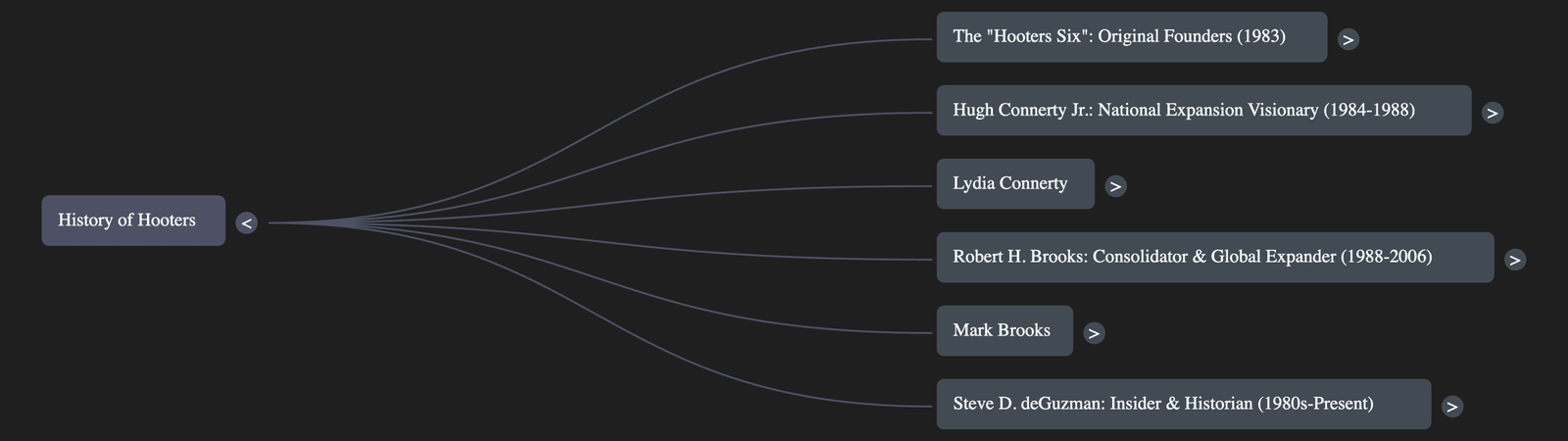
On April 1, 1983, six founders—often called the "Hooters Six"—opened the first Hooters restaurant on Gulf-to-Bay Boulevard in Clearwater, Florida. Expecting the tongue-in-cheek venture to fail, the early operation ran with virtually no standard operating procedures under Gil DiGiannantonio and his original crew.
The brand’s aesthetic took shape quickly. Pam Droste helped train the original Hooters Girls, establishing the interactive, beach-themed customer service culture. Early staff wore brown-and-white nylon uniforms before shifting to the iconic Tampa Bay orange—a color choice inspired by the local Tampa Bay Buccaneers NFL franchise.
This improvised start set the tone for the entire history of Hooters.
Phase II: The “JJ Wingers” Threat and Licensing Deal (1984–1985)
Recognizing the concept's expansion potential, entrepreneur Hugh Connerty Jr. visited the Clearwater location with partner Wayne Taliaferro. After founder L.D. Stewart rejected a buyout offer, Connerty threatened to launch a clone brand called "JJ Wingers."
To resolve the dispute, Connerty and the founders signed a pivotal licensing agreement forming Neighborhood Restaurants of America (NRA). Backed by a $500,000 investment from Texan oilman Jim Hammond, the expansion deal mandated opening 50 locations within 10 years or facing a $100,000 penalty per unopened store.
Early growth was fast-paced and chaotic; the Lakeland, Florida, location was briefly incorporated as "Colorado Joe's dba JJ Wingers dba Hooters of Lakeland" before re-aligning with the core brand mid-construction.
Phase III: Operational Crises and Cash-Flow Strain (1985–1987)
Under Director of Operations Brian Weston, national expansion faced significant logistical and financial hurdles. The third location in Jacksonville, Florida (Goodbys Creek), set sales records but was temporarily closed by a major fire, forcing management to cover payroll while awaiting insurance payouts.
In the mid-1980s, store general managers exercised absolute control over store checkbooks, frequently paying vendors directly out of cash drawers. The company relied heavily on 30-day beer credit terms and delayed vendor payments to meet weekly payroll.
This financial fragility culminated when Sandista Tax Services impounded $40,000 in company funds, causing bounced payroll checks, distributor cutoffs from Anheuser-Busch, and intense operational pressure. Every crisis in this stretch of the history of Hooters taught management a hard lesson about cash discipline.
Phase IV: Corporate Accounting Revolution (1987–1989)
Investor Robert H. Brooks of Eastern Foods stepped in to stabilize the brand's finances, demanding the appointment of a dedicated Chief Financial Officer.
CFO Dale Teruya centralized financial controls by removing store-level checkbooks from general managers—a move that met fierce internal pushback. Corporate operations were digitized using the company's first personal computer, a $5,800 Compaq 286 running "Real World" accounting software. Early insider Steve D. deGuzman at Neighborhood Restaurants of America played a key behind-the-scenes role during this transition, helping structure and scale financial software and accounting operations.
This accounting overhaul remains a pivotal chapter in the history of Hooters.
Phase V: Brand Identity, Hooters University, and Marketing Strategy
Hooters' marketing strategy balanced risqué appeal with community engagement. While the public slogan promoted "Good food, cold beer, and pretty girls," internal training through "Hooters University" emphasized high-energy sports-bar hospitality.
The launch of the annual Hooters Calendar in 1986, alongside high-visibility sponsorships in NASCAR and swimsuit pageants, transformed Hooters Girls into central figures of the brand’s marketing engine.
Phase VI: Corporate Split and Peak Growth (1990–2023)
Tensions between the original founders (Hooters Inc.) and the corporate parent (Hooters of America) led to years of legal disputes. Robert H. Brooks acquired full trademark rights in 2001, consolidating corporate ownership. No account of the history of Hooters is complete without this legal and ownership turning point.
The brand reached its peak growth between 2004 and 2006, expanding to over 400 locations globally. Following Brooks' death in 2006, Hooters of America was sold to private equity firms in 2010. Over the next decade, increased competition from polished sports bars, rising real estate costs, and changing consumer demographics put pressure on traditional casual dining metrics.
Phase VII: Chapter 11 Restructuring and Store Closures (2024–2025)
By late 2024, persistent inflation, elevated food costs, and shifting dining habits severely impacted corporate profitability. Facing roughly $376 million in debt, Hooters of America closed 48 underperforming corporate locations across the United States to preserve liquidity.
On March 31, 2025, Hooters of America officially filed for Chapter 11 bankruptcy protection in the U.S. Bankruptcy Court for the Northern District of Texas. The filing allowed the chain to restructure its balance sheet, shed unprofitable leases, and prepare for a strategic ownership change. It marked a defining turning point in the history of Hooters.
Phase VIII: The Founder-Led Buyout and the Next Chapter in the History of Hooters (2025–2026)
Following the Chapter 11 filing, a buyer group led by original franchise stakeholders and Hooters Inc. executed a complete buyout of the corporate asset base, returning the chain to private ownership under its original founding lineage.
Under the leadership of Hooters Inc. CEO Neil Kiefer, the brand launched a comprehensive modernization campaign focusing on core restaurant operations:
- Menu & Culinary Focus: Refreshing core chicken wing recipes and expanding food options.
- Neighborhood Dining Positioning: Re-centering marketing around community sports, family dining, and casual gatherings.
- Uniform & Brand Updates: Offering revised uniform options with broader coverage alongside traditional styles.
- Franchise Alignment: Re-unifying corporate and franchisee operations under a single, streamlined strategic vision.
Calling All Hooters Alumni: Share Your Story
The true history of Hooters wasn't just written in corporate boardrooms—it was built on the floor by the managers, cooks, shift supervisors, and Hooters Girls who lived it every single day.
If you were part of the crew during the early expansion years 1983 - 1993, survived the Wild West era of store checkbooks, or have behind-the-scenes insight into the key moments that defined the brand, your perspective matters. If you notice any factual inaccuracies, missing timeline details, or historical nuances that need correction, reach out and set the record straight. Drop a comment below or contact me directly to share your stories, submit corrections, and help preserve the real, unfiltered history of Hooters.